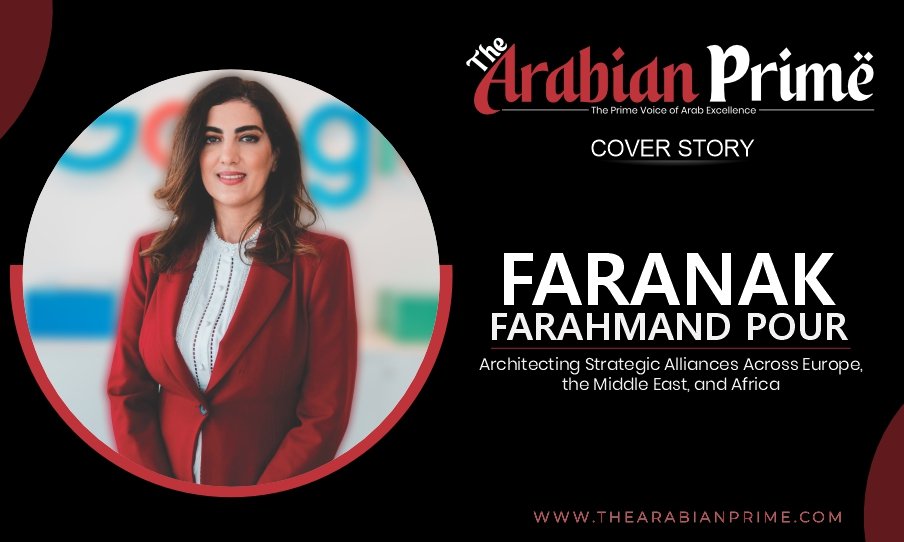
Faranak Farahmand Pour: Architecting Strategic Alliances Across Europe, the Middle East, and Africa
A leadership journey grounded in trust, cultural understanding, and purposeful decision making!
Every long-term partnership begins with a conversation that asks for patience, clarity, and the ability to see the person before the position. In global business, deals stretch across borders, values differ, and expectations shift with every market, yet progress depends on how well people listen before they speak and how steadily they carry responsibility when stakes rise.
That approach defines the professional journey of Faranak Farahmand Pour, Director of Global Strategic Initiatives at Google, where she leads strategy and negotiation for some of Google’s largest and most complex partnerships across Europe, the Middle East, and Africa. Her work sits at the intersection of business judgment, cultural awareness, and human trust, built through years of experience across industries and regions.
Her career began in legal counsel roles at Philips and SAP, where precision, accountability, and structure formed a strong foundation. Over time, her interests expanded toward strategic deal-making and digital transformation, guided by lived experience across cultures and industries. Moving between countries from a young age brought early exposure to difference, adaptation, and resilience, lessons that later became practical strengths in global leadership.
Courage runs through every phase of her work, from stepping into new countries to moving from a successful legal career into business leadership, and from navigating unfamiliar environments to leading multi-billion dollar negotiations. Each step demanded comfort with uncertainty and commitment to responsibility.
Curiosity fuels her engagement with diverse markets such as China, the UAE, and Europe, encouraging a deeper understanding of ideas, cultures, and motivations.
Connection anchors her leadership style, built on a genuine interest in the person across the table. For Faranak, lasting partnerships grow from human trust, developed through respect, presence, and consistency rather than titles or hierarchy.
Together, these qualities position her as a leader who builds alliances that last, guided less by scale or speed and more by the steady work of earning trust across people, cultures, and decisions.
The Pull Toward Strategic Influence
Career paths often begin with curiosity before they become conviction. For Faranak, the pull was never limited to one discipline. She was interested in how law, business, and culture intersect and influence outcomes in real life.
Her professional journey did not start with a fixed destination, but with curiosity about how systems, people, and decisions intersect. Early on, she was less interested in surface-level roles and more focused on where real influence is shaped.
She was always fascinated by the intersection of law, business, and culture. Her legal career gave her a fantastic analytical toolkit, but she was drawn to the commercial and strategic heart of the deal. Her inspiration came from a desire to not just paper the agreement, but to architect the partnership itself.
Her mission has evolved significantly over time. Initially, it was about proving she could succeed. Today, her mission is to use her unique position to build bridges between technology and society, between different business cultures, and between aspiring female leaders and the opportunities they deserve.
Leadership Formed by Displacement
Long before leadership became a title, it became a survival skill. Her worldview and leadership philosophy were shaped early by transition, displacement, and adaptation.
Her most formative experience was immigrating from Iran to the Netherlands as a young girl. Arriving in a new country without knowing the language or the culture forced her to become an astute observer and a quick learner. It taught her resilience, adaptability, and deep empathy for what it feels like to be an outsider.
This experience is the bedrock of her leadership philosophy. It taught her to listen more than she speaks, to seek to understand before seeking to be understood, and to value the diverse perspectives that different backgrounds bring to the table.
Where Vision Meets Execution
Leading initiatives requires more than vision. It requires the discipline to translate intent into execution without losing direction.
She believes vision and execution are two sides of the same coin. A vision without execution is merely a dream. She balances them by anchoring the team in the “why,” the long-term strategic value they aim to create, while empowering them with the autonomy to determine the “how.”
In practice, this means being deeply involved in the initial strategic framing of a deal but then trusting her team of experts to lead their respective workstreams. Her role is to clear roadblocks, ensure alignment, and keep eyes on the North Star, ensuring that daily actions are always in service of the ultimate goal.
A Career Shift that Changed Direction
Certain moments quietly alter the direction of a career. For her, one such moment reshaped how she viewed her own potential.
The most pivotal moment was her transition from law to a commercial leadership role at SAP. A senior leader saw a spark in her that went beyond her legal expertise and gave her the opportunity to lead strategic initiatives. It was a leap of faith for both of them.
This moment was transformative because it affirmed her intuition that her legal background could be a superpower in a business context. It gave her the confidence to own her unique, non-linear career path and set her on her current trajectory, where she can leverage her full skill set to architect complex, high-stakes partnerships.
Leading Beyond the Playbook
Leadership in the Middle East demands a different orientation. Established playbooks do not always apply in environments moving at the pace of transformation.
Traditional leadership often relies on established hierarchies and proven playbooks. Visionary leadership, particularly in a dynamic region like the Middle East, is about charting a course through uncharted territory. It is about foresight, anticipating market shifts, seeing opportunities for co-innovation before they are obvious, and inspiring a shared belief in a future that does not exist yet.
In the Middle East, this means moving away from a vendor-client mindset to building true ecosystems of partnership that can accelerate national transformation agendas and create entirely new sources of value.
Authority in Male-Dominated Spaces
Her leadership journey has also been shaped by visibility gaps and structural realities that many women face.
Like many women, she has often been the only woman in a male-dominated room. Early in her career, the challenge was ensuring her voice was heard and her contributions were recognized. Instead of being discouraged, these experiences strengthened her resolve. She learned to be exceptionally prepared and to communicate with conviction.
It also shaped her leadership style to be more inclusive and collaborative. She embraces what she calls “female energy,” leveraging intuition, empathy, and a focus on connection to disarm adversarial dynamics and build consensus.
Purpose Built on Connection
Beyond titles and roles, her work is guided by a consistent internal compass.
Her core purpose is to be a connector of people, ideas, and opportunities, to unlock shared potential. Whether it is connecting a partner to the transformative power of Google’s AI or connecting a mentee to her own inner strength, she is fueled by the impact that can be created together.
Her commitment to empowering others, especially women, stems from this purpose. She firmly believes that when you lift others, you rise as well, creating a powerful ripple effect of positive change.
Clarity Under Pressure
High-stakes environments demand clarity, not reaction. Her approach to decision-making is deliberate and structured.
In high-pressure situations, her approach is anchored by three principles.
- Preparation: She relies on meticulous preparation and data to provide clarity amidst the noise.
- Perspective: She actively seeks out diverse viewpoints from her team. Pressure can create tunnel vision, and different perspectives are the antidote.
- Principle: She stays true to her core values and long-term objectives. She asks herself, “Will this decision stand the test of time and reflect the kind of partner we want to be?”
This principled anchor prevents reactive, short-term choices.
Separating Innovation From Noise
With innovation dominating leadership conversations, discernment becomes critical.
Genuine innovation, in her view, solves a fundamental problem or creates a significant new capability, and it has a clear path to creating sustainable value. She distinguishes it from mere trends by asking critical questions.
- Does this create a 10x improvement, or just an incremental one?
- Is it scalable?
- Most importantly, is it built on a deep understanding of customer needs, or is it just a technology in search of a problem?
Sustainable innovation, for her, is always customer-centric.
Mentorship as a Long-Term Commitment
Leadership growth often depends on the people who step in early, recognise potential, and offer guidance at moments of uncertainty. For Faranak, mentorship has played a defining role in shaping her confidence and approach to leadership.
She has been fortunate to have several mentors who saw her potential and pushed her to take on challenges she did not think she was ready for. Her greatest influences have been leaders who gave her both their trust and their candid feedback.
She pays it forward by being an active and engaged mentor for women within Google and across her wider network. For her, mentorship is about helping mentees find their own voice, build confidence, and navigate the complexities of a global career. It remains one of the most rewarding aspects of her work.
Partnerships Designed for Impact
When leadership moves from intent to action, the real test appears in the kind of initiatives a leader chooses to prioritise and the depth of change those initiatives create across an ecosystem. For Faranak, the focus remains on creating an impact that develops with the region rather than acting on it from the outside.
While the details of her deals remain confidential, Faranak is immensely proud of the large-scale, multi-pillar partnerships she and her team have structured with some of the biggest enterprises. These partnerships are not simple technology transactions. They are deep, strategic alliances where Google’s AI and Cloud technologies are embedded to help partners transform their business models.
These achievements reflect her vision for impact. The emphasis remains on driving growth with the region through true, collaborative innovation, building relationships that support long term progress and shared value.
Teams Built on Psychological Safety
As organisations grow and take on greater responsibility, leadership culture often determines whether teams simply complete work or genuinely perform with ownership and confidence. The way leaders create space for people to think, speak, and contribute plays a decisive role in sustaining long-term success.
Faranak cultivates her teams on a foundation of psychological safety. She creates an environment where every member feels safe to speak up, challenge existing approaches, and even fail, with the shared understanding that learning happens together. Inclusivity is strengthened through an intentional focus on diverse perspectives and collaborative decision-making. High performance follows naturally when people feel trusted, valued, and empowered to bring their whole selves to work.
The State of Female Leadership Today
Female leadership in the Middle East has moved beyond symbolism, but work remains. For her, Female leadership in the Middle East today is a powerful force of transformation. Women are at the forefront of innovation in every sector, bringing a unique blend of resilience, strategic acumen, and collaborative spirit. However, there is still progress to be made.
She believes the focus must move beyond celebrating “firsts” and work towards normalizing female leadership at every level, especially in the C-suite and on boards. This requires dismantling systemic barriers and creating more equitable pathways for advancement.
Forces Redefining the Next Decade
Projecting towards the future, she sees leadership being reformed by converging forces. The convergence of AI, the global focus on sustainability (ESG), and the shift towards purpose-driven work will redefine leadership. The skills that will be most prized in the next decade, empathy, collaboration, communication, and adaptability, are areas where women often demonstrate strong leadership.
As AI automates routine tasks, the premium on human-centric leadership will skyrocket. This presents a monumental opportunity for women to lead in this new era of business.
A Message to the Next Generation
Her advice to future leaders is rooted in lived experience, not abstraction. She conveys, “Your unique perspective is your greatest asset, not a liability. Embrace it. Build your tribe, a network of mentors and peers who will champion and challenge you. Be relentlessly curious, step into roles that scare you, and never underestimate your own capabilities. Leadership is not about a title; it is about impact. Trust your instincts, take calculated risks, and know that your voice has the power to shape the future.”