
Andrea Mauri – Redefining Sports Infrastructure Through Vision, Sustainability, and Global Integration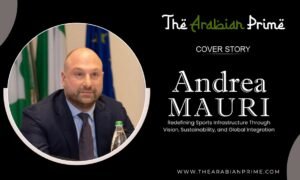
Life is a sport for many. But if sport is life for you, then you must meet Andrea Mauri, the Chief Executive Officer (CEO) of Cantù Arena, at this fantabulous facility.
The Project of Cantù’ Arena: A Long Lasting Sustainable “Home” For Pallacanestro Cantù’
From Andrea’s grand vision, drafted in the heart of northern Italy, halfway between Milan and Como Lake, Cantù Arena is set to become the “home” of the pro basketball team Pallacanestro Cantù, also known as “Queen of Europe”, featuring a new kind of entertainment facilities in the country.
Born with the need to create a strategic modern headquarters for the club venue worthy of its history, the project of the venue went beyond this. A mixed-use arena shapes the core business of the infrastructure set to become a point of reference for the community of Cantù and the people living in the surrounding areas. The Arena will be a meeting point, a symbol of aggregation and social reference, says Andrea.
Cantù Arena is the first venue in Italy to fit in the context of a 3.0 arena by bringing digital innovation, technology, and flexibility to the building. These characteristics will guarantee a constant flow of people and will allow to host a wide range of events (sports, fairs, exhibitions, concerts,…). This is the first construction in our country to have used the “Legge Stadi” (Stadium Law – PPP) and project financing, breaking the record for timing for the approval of the project works. Furthermore, the first venue in the country to offer the Personal Seat License (PSL), a paid license for the purchase and consequent ownership of the seat, he informs.
A 40 million Euro investment for an arena that offers 5.200 seats, seven suites, and three lounges. In addition, a 1.000 msq pavilion rises next to the main building, which can be used as a training field with an internal grandstand with 150 seats or to host additional events. Outside the Arena in front of the Pavillion, the Event Plaza can be used as a field with stands for international 3v3 competitions. The site includes an area of 2.000 msq to be used for catering, the offices of Cantù Arena and Pallacanestro Cantù, and a store, reveals Andrea.
Meet the Majestic Leader
Defining the next-generation sports infrastructure in today’s global context, Andrea Mauri says that it is not just about constructing arenas: it is about building integrated ecosystems.
In today’s global landscape, a modern arena needs to function 365 days per year as a platform that is socially relevant, economically resilient, technologically advanced, and environmentally responsible. The most progressive venues worldwide are no longer single-purpose buildings; they are multifunctional urban accelerators that generate continuous value for communities, investors, and stakeholders.
The venues combine sports, entertainment, hospitality, digital connectivity, and public engagement into one cohesive infrastructure system. In this sense, the Arena becomes a strategic asset: both a physical landmark and a digital platform.
Personally, the next-generation infrastructure must achieve three objectives simultaneously: create sustainable financial models, drive urban regeneration, and elevate the cultural identity of its territory. Cantù Arena has been conceived precisely with this multidimensional vision, adds Andrea.
A Dream Designed to Remain Relevant for Decades
There is a very sporty vision that guided the development of Cantù Arena as more than just a sports venue, shares Andrea. “From the outset, our ambition was clear: Cantù Arena would not simply be a venue for the professional and local basketball team Pallacanestro Cantù; it would be a long-term strategic investment designed to remain relevant for decades.”
Andrea Mauri and his team approached the project with a fully integrated mindset: design, construction, and operations were aligned from day one. Too often, infrastructure projects are architecturally ambitious but operationally fragile. They reversed that logic: operational sustainability shaped design decisions.
Flexibility was central. The Arena has been engineered to host basketball, international competitions, concerts, corporate conventions, and large-scale entertainment productions because adaptability ensures long-term economic stability. But beyond functionality, the deeper vision was to create a symbol of transformation, an infrastructure capable of repositioning Cantù within the broader European sports and entertainment landscape.
A Strategic Vision
There is a strategic leadership vision by the power of which Cantù Arena balances commercial viability with cultural, community, and sporting impact. Andrea Mauri explains that ‘true leadership in infrastructures lies in reconciling profitability with purpose.’ Cantù Arena was inspired by the most advanced international models (particularly in North America and Northern Europe) and adapted to the unique heritage of its territory, Pallacanestro Cantù, and its passionate fan base. The commercial sustainability is not separate from the community impact: it enables it. A financially solid arena can reinvest in fan engagement, youth programs, cultural events, and long-term sporting competitiveness.
Andrea Mauri adds, “Our model strengthens the club’s economic foundation while preserving its identity.” A successful team in a state-of-the-art arena creates a virtuous cycle: sporting excellence fuels commercial growth, and commercial growth sustains sporting ambition. In this alignment, infrastructures become a multiplier of both economic and emotional value. Also, the project relies on the know-how of the ownership group, which counts on a versatile visionary structure, including the expertise of Bennet S.p.A. in the retail and large-scale distribution industry.
Sustainably Sound
According to Andrea, ‘sustainability is not an accessory, it is a structural principle.’ Within their shareholder structure, they have A5, part of the A2A Group, one of Italy’s leading multi-utility companies. Their involvement ensures that the Arena’s energy systems were designed with long-term operational efficiency in mind and will be managed throughout the concession period.
Andrea Mauri and his team of experts implemented advanced energy optimization systems, smart building technologies, and predictive maintenance platforms to reduce consumption and maximize performance. This integrated model transforms sustainability into measurable operational performance. Environmental responsibility aligns directly with cost efficiency and long-term asset value preservation.
Fan Experience – The Emotional Engine Powering the Project
The Arena is not only built to host events, but it is engineered to perform intelligently over time. Andrea Mauri also informs that fan experience plays a crucial role in shaping infrastructure decisions, from design to digital integration. Fan experience is the emotional engine of the entire project. From architectural flow to digital infrastructure, every decision has been filtered through the lens of immersion, accessibility, and engagement.
Cantù Arena will operate on a 5G-enabled digital backbone, supporting integrated applications for ticketing, cashless services, hospitality, safety, and personalized interaction. The objective is seamless connectivity—where physical presence and digital services enhance one another in real time. Modern audiences expect more than attendance; they expect participation. They look for frictionless access, immersive audiovisual experiences, premium comfort, and customization. “By embedding digital intelligence into physical design, we are shaping not just a venue, but an experience-driven platform,” says Andrea. Lastly, AI is shaping the way we can analyze data. The key here is being capable of contextualizing what information we have to deliver high standards of service, entertainment, and management.”
The Regional Economic Catalyst
Multipurpose arenas like Cantù Arena contribute tremendously to regional economic development and urban regeneration, believes Andrea. Infrastructures of this scale act as a catalyst. The direct economic impact includes job creation, supply chain activation, and event-driven revenues. Indirectly, the arenas stimulate hospitality, tourism, and commercial redevelopment, he adds.
But beyond numbers, there is symbolic capital. A modern arena signals ambition, confidence, and openness to global engagement. Public and private investments in sports infrastructure can requalify entire districts and redefine a city’s strategic positioning. Cantù Arena represents a long-term legacy project, one that will contribute not only economically but socially and culturally to the region’s evolution, says Andrea, who also sees data, analytics, and digital platforms transforming stadium and arena management with a different lens. According to him, data is becoming the central nervous system of modern arenas.
*Operationally, real-time analytics improve energy efficiency, maintenance planning, security coordination, and crowd management.
*Commercially, data enables dynamic pricing, measurable sponsorship ROI, and targeted fan engagement strategies.
*Strategically, digital platforms transform arenas from event-based facilities into year-round engagement ecosystems.
The competitive edge will belong to venues that integrate physical infrastructure with digital intelligence, where every interaction becomes insight, and every insight becomes a strategic advantage.
The Lessons Learnt
Also, there are many lessons from international sports infrastructure models that have influenced Andrea’s approach in Italy. He reveals that the international benchmarking has been transformative. “Our partnership with Legends Global (one of the world’s leading premium venue operators) brought global expertise into a market that traditionally lags in sports asset management.” Their contribution provided advanced operational models, commercial frameworks, and data-driven strategies aligned with global standards. “This collaboration allowed us to leapfrog legacy limitations and position Cantù Arena within an international network of excellence.”
The Indispensable Public-Private Partnership
In executing and sustaining large sports infrastructure projects of this magnitude, Andrea Mauri says that the public–private partnerships are indispensable. Cantù Arena represents one of the first Italian PPP cases successfully executed under the stadium law framework. Such collaborations align public interest objectives with private efficiency and capital discipline. Given the significant economic and social spillovers, shared responsibility is both strategic and necessary. Infrastructure of this scale does not simply serve events; it reshapes territories.
While managing such large-scale, long-term infrastructure projects, there are some solid leadership principles that guided Andrea. “My philosophy rests on strategic clarity, disciplined execution, and collective empowerment. Large-scale infrastructure requires long-term vision combined with rigorous governance. Transparent accountability structures build credibility among investors and institutions. Stakeholder alignment is fundamental: public authorities, private partners, communities, and sports organizations must operate within a shared strategic framework. Risk management must be anticipatory rather than reactive. Complexity demands structured foresight. Above all, empowering multidisciplinary teams creates resilience. Innovation emerges when expertise is trusted, and collaboration is structured. Leadership, in infrastructure, means orchestrating complexity with consistency, he insists.
The Logically Critical Advice
As an experienced leader, to other emerging leaders aiming to enter sports infrastructure and venue management, Andrea’s advice is logical. He believes that ‘specialization is critical. In markets where structured expertise is still developing, leaders must invest heavily in international exposure and technical knowledge. “Over the past five years, I dedicated myself to studying global best practices and collaborating with specialized operators. That foundation was essential.”
Sports infrastructure is multidisciplinary: spanning finance, design, construction, digital integration, operations, and commercial strategy. Without comprehensive expertise, projects risk remaining visionary renderings rather than sustainable realities. Excellence in this field demands continuous learning and a global perspective.
Meeting the Next Global Challenges Head-On
Further, in Andrea’s view, the next global challenge is not merely constructing multi-use and sustainable venues. It is ensuring an integrated ecosystem sustainability.
When an arena hosts a primary tenant, such as a professional club, the strategic objective expands: the infrastructure must generate diversified revenue streams that reinforce the club’s long-term competitiveness. Premium hospitality, naming rights, data-driven sponsorship models, international events, and year-round programming are no longer optional: they are structural necessities.
Ultimately, the infrastructure’s success depends on synchronization. A high-performing club within a high-performing arena generates mutual reinforcement. Without that balance, even the most impressive facility risks underperforming. The future belongs to projects that integrate sports performance, operational excellence, and financial intelligence into one unified model.
Benchmarking Excellence for Southern Europe
Finally, looking ahead, Andrea Mauri says that their long-term vision is to position Cantù Arena as a benchmark for Southern Europe. “Through our partnership with Legends Global, we aim to integrate the arena into the international event circuit: hosting high-profile sporting competitions, concerts, and global entertainment productions.”
“At the same time, we remain deeply anchored in our local identity and basketball heritage.” The ambition is clear: to demonstrate that innovation, sustainability, and community roots can coexist within a globally competitive infrastructure model. Cantù Arena is not merely a venue, it is a statement of intent about the future of sports infrastructure in Italy and beyond, he concludes.