
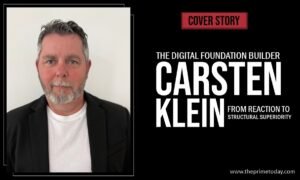
The Digital Foundation Builder – Carsten Klein: From Reaction to Structural Superiority
Fluorescent lights flicker across rows of steel server racks, illuminating the hidden machinery that powers modern enterprise. Within these humming cabinets, miles of cable carry the lifeblood of business. For many IT leaders, these rooms inspire not confidence, but unease. Years of layered tools, patches, and reactive fixes have created digital fortresses so complex that their own architects no longer fully understand them.
Carsten Klein stands calmly at the center of this controlled chaos—but he isn’t searching for another alarm system. His focus lies deeper: on the structural integrity of the foundation itself.
He understands the cycle of fear that governs much of today’s cybersecurity landscape. Organizations wait for alerts that signal failure has already occurred, locked in a reactive game where attackers need only exploit a single overlooked weakness. In fragmented systems, that weakness is inevitable.
As the Co-founder and Chief Executive Officer (CEO) of KraLos GmbH, (along with another Co-founder, Christian Greiwe), Klein approaches cybersecurity not as a technician, but as a builder. Where others see dashboards, he sees structural flaws. Where others add tools, he removes complexity. His philosophy is simple but radical: security must exist at inception. A system flawed at its core cannot be repaired through layers of after-the-fact protection.
Across Europe, in discreet boardrooms and strategy sessions, Klein challenges technology leaders to confront uncomfortable truths. He asks them to look beyond polished vendor promises and identify the gaps between systems—the spaces where risk lives. His vision is not abstract. It is practical: reduce the attack surface, restore clarity, and make control tangible rather than theoretical.
Outside, the digital world accelerates relentlessly. Threats evolve by the minute. Klein does not wait for crises. He works to ensure they never materialize.
The Evolution of Security: From Suspicion to Trust
For Klein, the future of cybersecurity lies in digital trust. While the industry has long embraced the concept of Zero Trust—eliminating implicit assumptions of safety—its implementation has often led to increased complexity and operational friction.
Klein’s approach moves beyond perpetual skepticism toward contextual, intelligent trust. Trust, in this model, is neither assumed nor denied—it is continuously verified.
At KraLos, this philosophy takes shape through two complementary systems. Phishing-Guard uses AI to analyze communication patterns in real time, identifying threats such as phishing and social engineering before they reach the user. WEBOUNCER, by contrast, embeds security directly into system architecture through a Secure-by-Design approach, minimizing vulnerabilities before they exist.
The distinction is fundamental. Zero Trust asks, “Why should I trust?” Digital Trust reframes the question: “Under what conditions can trust be established—right now?”
The Turning Point: When Humans Became the Target
Klein’s perspective was shaped not by a single defining moment, but by a convergence of industry shifts. Chief among them was the realization that cyberattacks had evolved beyond exploiting technical flaws. Increasingly, they target human behavior.
Phishing campaigns became more sophisticated. Social engineering grew more precise. AI-enabled attacks introduced unprecedented scale and adaptability. Traditional perimeter defenses proved too slow, too static.
At the same time, organizations responded by adding more tools—SIEM systems, firewalls, endpoint protection—without integrating them effectively. Complexity increased, but control did not.
A new reality emerged: the window between breach and damage shrank to minutes. Reaction was no longer sufficient. Prevention had to become structural.
From this realization, Klein’s vision took shape—an integrated platform combining preventive architecture with intelligent, context-driven verification. Cybersecurity, in his view, must evolve from a reactive safeguard into a proactive driver of value.
Human-Centric Security: Where Logic Meets Intuition
Despite its technical nature, cybersecurity is ultimately a human problem. Klein recognizes that risk often arises at the intersection of systems and behavior.
Rather than designing security against users, KraLos builds it around them.
Phishing-Guard incorporates behavioral analysis that mirrors human intuition—flagging communications that feel “off,” even when technical indicators appear normal. This intuition is scaled through AI, enabling systems to think more like experienced professionals without overwhelming users.
WEBOUNCER takes the opposite approach: it removes the burden of decision-making entirely. By embedding security into architecture, risks are eliminated before they become visible. Users are not asked to act—they are protected by design.
The result is a system that behaves like a trusted colleague: vigilant, intelligent, and unobtrusive.
Predictive Intelligence: Stopping Attacks Before They Begin
While many organizations claim to use artificial intelligence, Klein distinguishes between reactive detection and predictive prevention.
At KraLos, intelligence operates across the entire attack lifecycle. Communication flows, behavioral patterns, and anomalies are continuously analyzed to identify not only known threats, but emerging ones.
In parallel, WEBOUNCER employs digital twin technology to simulate attacks against its own infrastructure. Vulnerabilities are identified and eliminated before they can be exploited in real-world conditions.
This approach fundamentally shifts the timeline of cybersecurity. Instead of responding to attacks, systems interrupt them during development—or prevent them altogether.
Compliance as Architecture, Not Afterthought
As regulatory frameworks such as GDPR and NIS2 grow more stringent, many organizations struggle to balance innovation with compliance. Klein rejects the notion that this is a trade-off.
For him, compliance is not an external requirement—it is a design principle.
KraLos addresses this through three core strategies: ensuring data sovereignty by design, separating data from analytical logic to protect privacy, and reducing complexity through standardization. By embedding governance into architecture, companies can scale globally without compromising local regulatory requirements.
Innovation, in this model, does not conflict with compliance—it anticipates it.
Democratizing Cybersecurity for the Mittelstand
While large enterprises dominate cybersecurity spending, mid-sized businesses often lack access to effective solutions. Klein sees this as both a challenge and an opportunity.
His goal is to make enterprise-grade security consumable.
By consolidating functions into a unified architecture, automating key defenses, and ensuring seamless scalability, KraLos enables smaller organizations to achieve high levels of protection without excessive cost or complexity.
Security, in this context, becomes not a luxury—but a standard.
Structural Superiority of Cyber Warfare
In a world of increasingly sophisticated, state-sponsored attacks, Klein rejects the idea of a technological “arms race.” Matching attackers tool-for-tool is neither sustainable nor effective.
Instead, he advocates for structural superiority.
This means reducing attack surfaces through architecture, applying intelligence selectively where it matters most, continuously simulating threats, and prioritizing resilience over perfection. Systems are designed not only to resist attacks, but to remain functional and recover rapidly when breaches occur.
The objective is clear: change the rules of the game so that attacks lose their impact by design.
The Rise of the Chief Trust Officer
As cybersecurity evolves, so too does leadership. Klein يرى the traditional role of the Chief Information Security Officer expanding into something broader: the management of trust itself.
Future leaders will not only protect systems—they will shape how organizations are perceived by customers, partners, and regulators. Trust will become measurable, strategic, and directly tied to business success.
In this new paradigm, cybersecurity is no longer a technical function. It is a cornerstone of brand and value creation.
Trust as the Currency of the Digital Age
For Klein, the ultimate goal is a fundamental shift in perception.
Today, cybersecurity is often viewed as a necessary burden—something that slows innovation. He envisions a future where it is recognized as an enabler of growth.
In that future, companies will measure success not only by revenue, but by trustworthiness. Security will no longer be a patchwork of tools, but an integrated foundation. Users will experience protection not as friction, but as seamless reliability.
If KraLos succeeds, Klein’s legacy will not be defined by technology alone, but by a new standard—one where trust becomes the central currency of digital transformation, and security its invisible foundation.