
Arsenal’s Modern Fortress: The Lasting Legacy of the Emirates Stadium
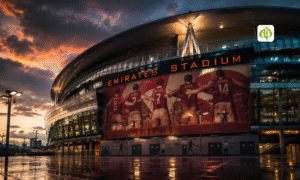
Long ago, folks began seeing stadiums not merely as buildings of metal, stone, and grass. Instead, they became places where people crowd together, moments stick hard in minds, while sorrow and wild joy flow freely. Shifting from Highbury in 2006 brought mixed feelings for Arsenal supporters – thrill tangled with longing. That site hosted the team starting back in 1913, standing quiet during golden times, even through the unbeaten run of the famed “Invincibles.” One era ended; another started, carrying echoes. Facing change became unavoidable once the game shifted. This new arena rising in North London wasn’t merely concrete and steel – instead, it rewrote how Arsenal manages money, connects with fans, competes on pitch.
From Highbury to Building Landmarks Worldwide
Money talks, so Highbury had to go. Stuck at about 38,000 seats and boxed in by homes on every side, growing bigger wasn’t an option. Without room to expand, cash flow stayed tight. Competing with Europe’s wealthier clubs? Nearly impossible under those limits. Stadium size meant less income, especially when others pulled ahead (Demil & Lecocq, 2010; Barnes & Harland, 2024).
Down the road only five hundred metres, they moved – bold move – to Ashburton Grove (Barnes & Harland, 2024). Costing more than three hundred ninety million pounds to build, the new Emirates Stadium welcomed fans into a modern space built entirely with seats, sixty thousand strong (Barnes & Harland, 2024). Crafted by Populous, a design team known for stadiums, it turned its back on old-style cramped UK pitches. A wide oval shape now rose instead, curving upward like something never seen before on such grounds (Barnes & Harland, 2024). From up top, the glassy curve of the roof flows into tier after tier of sharply raked seats, each one placed so nobody loses sight of the field. Right away, more fans meant heavier income on game days, pulling profit from the league’s surging worldwide fame.
The Crucial Evolution from Cold Bowl to Living Heritage
When the Emirates Stadium first opened, it faced a distinct cultural hurdle. Many traditional match-going supporters felt the new arena felt somewhat sterile and corporate compared to the intimate, art-deco charm of Highbury. Critics often dismissed the early structure as a generic “concrete bowl” that prioritised corporate hospitality over raw footballing heritage (Barnes & Harland, 2024). Recognizing this emotional disconnect, the club initiated a comprehensive, long-term project in 2009 known as “Arsenalisation” (Barnes & Harland, 2024).
This brilliant initiative sought to systematically inject the rich history of the club directly into the fabric of the modern stadium. Huge, iconic murals depicting thirty-two legends linking arms were wrapped around the exterior facade, effectively enveloping the stadium in a permanent embrace of its own history. The regular seating sections were creatively rearranged to spell out the club’s name across the lower tiers, and the historic clock from Highbury’s famous Clock End was replicated and proudly mounted high inside the arena. Through this deliberate blending of modern architecture and nostalgic graphic heritage, the stadium transitioned from a soulless commercial facility into a genuine home that truly honors its past (Barnes & Harland, 2024).
A Modern Catalyst for Epic Entertainment and Community Unity
Beyond its function as a fortress for the men’s first team, the Emirates Stadium has grown into a highly versatile hub for entertainment and a pioneer for inclusivity. In recent years, it has become the spiritual and literal home for Arsenal Women, hosting sold-out, record-breaking crowds that have fundamentally elevated the profile of women’s football on a global scale. The venue has also smoothly adapted to host massive summer music concerts, welcoming legendary international artists and turning North London into a prime cultural destination outside the traditional football calendar.
Furthermore, the design of the surrounding concourses and urban plazas acts as a massive community gathering space. On match days, the entire surrounding area transforms into an electric, multicultural fan zone filled with diverse food, local music, and shared experiences (Sebire, 2026). The stadium has successfully woven itself into the daily social life of the local community, serving as an urban anchor that provides jobs, fuels local businesses, and brings thousands of diverse individuals together under a single, unified banner of sporting passion.
Shaping the Bold and Ambitious Future of North London
Two decades after its initial groundbreaking, the Emirates Stadium stands as a glowing testament to the power of forward-thinking sports architecture. While the initial move demanded immense financial sacrifice and a challenging cultural adjustment, the stadium has undoubtedly achieved its original goal. It successfully provided the financial foundation required for Arsenal to consistently challenge for top honors at the absolute highest levels of world football (Demil & Lecocq, 2010; Mnzava, 2013). As the club looks toward the future, the Emirates Stadium remains perfectly positioned to adapt to new technological advancements, sustainability initiatives, and potential future expansions. It stands no longer in the shadow of Highbury, but proudly on its own merits—a gleaming, modern colosseum where new generations of fans continue to write the beautiful,