
Girish Kumar: The Culinary Innovator Determining Foodservice Through Custom Culinary
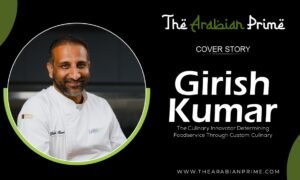
How Girish brings culinary expertise, consumer insight, global collaboration, and practical innovation together to create relevant foodservice solutions across the Middle East.
The food industry has always asked chefs to create something people remember. The harder task often begins after the first successful dish. Tastes change, markets become more demanding, operations become more complex, and the same quality must be delivered consistently across kitchens, locations, and markets.
For Girish Kumar, that challenge has become the foundation of a 24-year career spanning hospitality, culinary development, international food cultures, and foodservice innovation.
His journey began with Oberoi Hotels, an experience he remembers as entering a school where every day taught him something new. Those early years formed the chef he became, but they also shaped the person and leader he would grow into. The kitchen taught him that preparation matters, small details matter, ingredients deserve respect, and the people working beside you matter just as much.
Over time, Girish learned that excellence rarely arrives as one extraordinary moment. It lives in the ordinary things repeated with care until they become instinct.
That philosophy now informs his work as Director of Culinary, Middle East, for Custom Culinary®, the culinary-focused foodservice brand within Griffith Foods. Custom Culinary brings more than 70 years of experience to the development of authentic flavour solutions, including bases, sauces, gravies, soups, marinades, and other flavour systems designed for foodservice and food manufacturing customers.
In this role, Girish operates at the intersection of culinary creativity, customer needs, consumer expectations, and commercial product development. His work is not simply about creating something that tastes good. It is about understanding why a flavour matters, where it belongs, how it can be executed consistently, and how culinary inspiration can become a practical solution for a customer.
It is a larger interpretation of what it means to be a chef.
A Career Shaped by Every Stage of the Journey
Professional growth rarely follows a predictable route. The experiences that shape a person most deeply are often the ones that gradually change how they observe, respond, and make decisions.
When Girish looks back over 24 years, he does not see one defining moment. He sees many chapters, each preparing him for the next.
His early hospitality years gave him discipline and a strong culinary foundation. Working with different cuisines expanded his creative thinking. Moving to the Middle East pushed him outside his comfort zone and exposed him to cultures, flavours, consumers, and business environments very different from those he had previously experienced.
Travel became another important teacher.
Having opportunities to visit different parts of the world, experience cuisines in their cultural environments, visit markets, taste local food, and understand how people connect with food influenced the way he thinks about culinary development.
“You realise that cuisine is never just a recipe,” he says. “It carries history, geography, family, culture, and emotion.” That understanding is particularly relevant to his work today. Foodservice innovation cannot be separated from the people who will ultimately experience it.
His career at Griffith Foods has also given him opportunities to interact with chefs and culinary teams across the global network. Every conversation with a chef from another market brings a different perspective. The same ingredient can be interpreted completely differently depending on culture, consumer expectations, culinary tradition, and occasion.
Those exchanges have reinforced one of Girish’s strongest beliefs: no matter how experienced a person becomes, there is always another flavour, technique, culture, or person who can teach something.
After 24 years, he still considers himself a student of food.
Bringing Custom Culinary® Closer to the Customer
The transition from professional kitchens to a broader culinary leadership role changed the nature of Girish’s work, but it did not change the importance he places on understanding food from the ground up.
At Custom Culinary, that culinary perspective becomes part of a much broader process.
The brand works with restaurants, foodservice operators, chains, and food manufacturers that need flavour solutions capable of meeting specific operational and commercial requirements. A customer may be looking for a new sauce, a consistent base, a differentiated gravy, a practical soup solution, or a flavour profile that can help create a new menu experience.
For Girish, the starting point is always understanding the need behind the request.
What problem is the customer trying to solve?
Are they looking for consistency across locations? Do they need to simplify preparation? Are labour or equipment limitations affecting execution? Is the goal to create differentiation, localise a global concept, respond to a food trend, or develop something completely new?
These questions help transform culinary conversations into meaningful product-development opportunities.
His experience as a chef allows him to look at those requirements through the lens of real foodservice operations. He understands what happens during a busy service when time, labour, equipment, cost, consistency, and customer expectations all compete for attention.
An idea may look impressive during a controlled tasting, but the more important question is what happens when that idea has to be prepared hundreds of times in a real operation.
That is where culinary creativity meets commercial relevance.
From Culinary Inspiration to Commercial Innovation
Custom Culinary’s role goes beyond creating individual ingredients. Its portfolio of bases, sauces, gravies, soups, marinades, and other flavour systems allows culinary teams to help customers build solutions around specific foodservice needs.
Girish’s responsibility is to help connect those possibilities with what customers and consumers actually need.
This requires close collaboration with multiple functions. Culinary ideas need to work alongside food science, research and development, marketing, sales, quality, manufacturing, and customer requirements.
The chef may begin with an idea, but turning that idea into a scalable solution requires a wider team.
That collaborative model reflects how Girish approaches innovation. He does not view culinary development as a process where one person creates an idea, and everyone else simply executes it. The strongest solutions often emerge when different forms of expertise meet.
A chef understands flavour, preparation, technique, and the realities of a kitchen. Food scientists understand formulation and technical performance. Marketing teams understand consumers and positioning. Sales teams understand customer requirements. Manufacturing teams understand scalability and production.
Bringing those perspectives together can turn an interesting culinary concept into something that works commercially.
For Girish, that is one of the most rewarding aspects of his role.
When a customer tastes a solution, understands how it can work within their operation, and recognises that it addresses a genuine need, culinary creativity has moved beyond the kitchen and created tangible value.
Understanding the Consumer Behind the Trend
Culinary knowledge alone cannot determine what succeeds in the marketplace. Foodservice businesses must also understand how people discover food, what influences their choices, and why certain experiences remain memorable.
Today’s consumer is more internationally exposed than ever.
People travel, watch food content from around the world, discover new cuisines through digital platforms, read ingredient information, and encounter new flavours across markets. Someone can discover a food trend in Seoul, Bangkok, London, Mumbai, Mexico City, or New York and begin looking for a related experience elsewhere.
Travel has accelerated that curiosity.
Consumers return from holidays remembering a particular street food, sauce, spice, restaurant, or flavour experience and want to rediscover something similar at home.
At the same time, consumers want several things at once. They want novelty and familiarity, indulgence and mindful choices, convenience and quality, value and memorable experiences.
For businesses, understanding those seemingly competing expectations is essential.
Girish believes trend observation should always go deeper than simply identifying what is popular.
“Trends tell us what is happening; understanding people tells us why it is happening. And that ‘why’ is where meaningful innovation begins.”
This philosophy aligns closely with Custom Culinary’s focus on consumer and trend insights through its FlavorIQ® approach, which helps connect culinary development with a deeper understanding of flavour preferences, market movements, and consumer behaviour.
For Girish, insights become valuable when they can be translated into something practical.
The objective is not to chase every trend. It is to identify the trends that have genuine relevance and understand how they can be adapted to a particular customer, market, and consumer.
Be Global in Inspiration, Local in Understanding
Working across international markets has taught Girish that global inspiration only becomes meaningful when it is interpreted through local understanding.
Dubai was an important turning point in that journey because it expanded his culinary world.
What fascinated him about the Middle East was its diversity. People from dozens of nationalities can share the same city, restaurant, or dining occasion while bringing completely different memories, expectations, and relationships with food.
For a culinary professional, that creates both complexity and opportunity.
Living in such an international environment, combined with travelling and experiencing cuisines around the world, taught Girish to look beyond the dish itself. He observes how people eat, what they share, which ingredients are important to them, and how food fits into everyday life.
A local market or a simple street-food experience can sometimes reveal as much as an elaborate restaurant.
The lesson has become an important principle in his work: “Be global in your inspiration, but local in your understanding.”
A flavour or concept that succeeds in one country cannot automatically be transferred to another. Cultural preferences, dining occasions, ingredient familiarity, preparation methods, affordability, and consumer expectations all influence whether an idea will work.
For Custom Culinary, this local understanding is particularly important when developing solutions for customers across the diverse Middle Eastern market.
Finding Creativity Across Culinary Traditions
Once a professional begins working across different culinary traditions, creativity becomes less about following one fixed method and more about recognising the principles behind each cuisine.
“Every cuisine teaches you a different language of flavour,” Girish says.
Indian cuisine taught him the depth that can come from spices and layering. Mediterranean cooking showed him the power of freshness and simplicity. Italian cuisine reinforced the idea that when ingredients are good, sometimes the best approach is to let them speak for themselves.
Fusion taught him something else: culinary worlds can meet in exciting ways, but they need to meet with respect.
Travel has made those lessons richer. There is a difference between knowing a cuisine through recipes and experiencing it where it belongs. Tasting local food, walking through markets, speaking with chefs, and seeing how families and communities eat can reveal the cultural story behind a dish.
His interactions with culinary professionals across the Griffith Foods global community add another layer to that learning.
Sharing ideas with chefs from different countries allows professionals to challenge one another’s thinking. A flavour combination that feels familiar in one culture may feel completely new in another.
Those conversations can become the starting point for new ideas.
For Girish, creativity comes from this constant exchange of experiences. Everything people want to create is already somewhere around them; the challenge is having the eyes and ears to recognise it.
He believes the future of food will involve more conversations between cultures. The strongest fusion, however, will not erase culinary identities. It will respect them, celebrate them, and find an intelligent way to create something new.
Creating Solutions That Work in the Real World
Innovation becomes meaningful only when it survives the realities of foodservice.
Girish often begins with one simple question: Who are we creating this for?
It is easy for culinary professionals to become excited about a technique, ingredient, or concept. But consumers ultimately decide whether an innovation has value.
Taste remains the starting point. Food needs to create desire.
Beyond taste, Girish considers relevance, differentiation, affordability, operational simplicity, consistency, scalability, ingredient availability, and whether a concept genuinely fits the market.
That broader perspective is central to his work with Custom Culinary customers.
A solution may need to perform consistently across multiple locations. It may need to simplify preparation for kitchen teams. It may need to reduce complexity while preserving flavour. It may need to deliver the same experience despite differences in labour, equipment, or operating conditions.
These are not secondary considerations. They are part of culinary innovation itself.
Global exposure gives Girish a wide library of inspiration, but every idea still needs to pass through the filter of local relevance and customer reality.
Then comes another question: Will someone want it a second time?
Novelty can encourage a first trial. Repeat consumption demonstrates that an experience has become meaningful.
“The strongest concepts sit in that beautiful space between familiarity and discovery, enough comfort to connect with the consumer and enough surprise to be remembered.”
Making Creativity Work Within Practical Limits
Girish does not view constraints as the enemy of creativity. He believes they can make culinary professionals more thoughtful.
Food cost, preparation time, equipment, labour, ingredient availability, shelf life, consistency, and production scale all create boundaries.
Ignoring those realities can produce a wonderful culinary experiment, but it does not necessarily produce a successful foodservice solution.
Girish prefers to understand those boundaries early.
Once the parameters are clear, the question becomes: how creative can they be within this space?
This is where Custom Culinary’s broader capabilities become important. Culinary development can work alongside food science, technical expertise, manufacturing, sales, marketing, and quality to create solutions that are both inspiring and practical.
Sometimes simplifying an idea requires more creativity than making it complicated.
If a memorable flavour experience can be delivered while making execution easier and more consistent for the customer, Girish considers that powerful innovation.
“Creativity earns its value when it works in the real world.”
Leadership Beyond the Kitchen
The transition from professional kitchens into strategic culinary leadership also changed Girish’s understanding of what leadership means.
In a kitchen, leadership can be highly visible. A chef is present during service, making decisions, solving problems, and guiding the team in real time.
As his responsibilities expanded, Girish realised that leadership is not always about being the person with all the answers.
Sometimes it means asking the right question.
Sometimes it means bringing the right people together.
Sometimes it means giving someone else the space to discover a better solution.
Working with culinary colleagues across the Griffith Foods global network has reinforced this belief. He may have 24 years of experience, but when he sits with another chef from a different country or culinary background, he remains open to learning.
They exchange ideas, challenge assumptions, share successes and failures, and often arrive at better solutions together.
That has made collaborative leadership an important part of his approach.
Earlier in his career, he might have measured success through a beautiful plate or a successful service. Today, he also measures it through the people he helps develop, the customer problems teams solve, and the ideas that continue creating value after he has left the room. “Your impact should travel further than your presence,” affirms Girish.
Building the Future of Foodservice Through Custom Culinary®
The Middle East is becoming an increasingly important environment for culinary innovation. The region brings together global cuisines, strong local food cultures, international consumers, ambitious foodservice businesses, and rapidly evolving dining expectations.
Girish sees an opportunity for the Middle East to move beyond simply bringing global cuisines together.
He believes the region can increasingly develop culinary ideas that travel outward and influence other markets.
That future will involve global flavours alongside stronger localisation and more confident expressions of regional culinary heritage.
Convenience, mindful eating, sustainability, digitalisation, personalisation, and operational efficiency will continue influencing foodservice. Technology and consumer insights will help businesses understand customers and innovate with greater precision.
Yet Girish believes one element should remain central.
Hospitality is fundamentally human.
Technology can identify purchasing patterns. Data can reveal consumer behaviour. Product development can make operations more efficient. But food creates memories because it connects with emotion, culture, family, travel, celebration, and identity.
That is also where Custom Culinary’s philosophy of “Be True to the Food®” becomes relevant.
For Girish, authenticity does not mean refusing to innovate. It means understanding what makes a food experience meaningful and protecting that essence while finding better ways to deliver it.
The future of foodservice, in his view, belongs to businesses that can combine global knowledge, culinary expertise, food science, technology, and consumer insight with a genuine understanding of people and food.
Preparing Rather Than Chasing
Girish’s philosophy about career growth is captured in an image he often uses: catching a butterfly.
If someone sees a beautiful butterfly and immediately runs after it, the faster they chase, the further it may fly. Sometimes, if they remain patient, stay aware, and create the right environment, the butterfly comes closer.
He believes careers can work in much the same way.
Ambition, goals, and hard work matters. But people cannot control every stage of their professional journey.
Some of the most valuable experiences in Girish’s career, including travelling, discovering different cultures, meeting chefs from around the world, and finding himself in conversations he could never have imagined when he first entered a professional kitchen, could not have been planned perfectly.
One experience simply opened the door to another.
So, he focuses on becoming ready rather than becoming impatient.
His guidance is simple: learn, work sincerely, treat people well, travel when possible, listen to people’s stories, taste unfamiliar food, remain curious, and when an opportunity arrives, be prepared to recognise it.
Sometimes people become so focused on catching the butterfly that they forget to enjoy the garden around them.
For Girish, professional success is also about appreciating the people, cultures, experiences, and lessons encountered along the way.
Words of Wisdom
After more than two decades in the industry, Girish believes young chefs should resist the pressure to become successful too quickly.
Modern professional life makes achievement highly visible. People see promotions, awards, beautiful dishes, restaurants, and career milestones. They rarely see the years of repetition, mistakes, discipline, learning, and sacrifice behind them.
His advice begins with fundamentals.
Young chefs should understand how ingredients behave, learn why something works rather than simply memorising how to do it, and never consider any honest kitchen responsibility beneath them.
Small tasks often teach large lessons.
When opportunities arise, he encourages young professionals to travel. But he believes travel should be about understanding people, not simply seeing places.
Visit local markets. Eat where local people eat. Try unfamiliar food. Speak with chefs. Ask why an ingredient is used. Understand the history behind a dish.
Food, he believes, is one of the world’s most beautiful languages.
People may not speak the same language as the person sitting across the table, but they can still connect through a meal.
His work with culinary professionals across the Griffith Foods global community has reinforced that belief. Every chef brings a different story, culture, technique, and way of thinking. Knowledge grows when those experiences are shared.
He also encourages the next generation to think beyond the kitchen.
The modern culinary professional needs to understand consumers, business, technology, sustainability, operations, and communication. The chef of the future will not only create food; they will connect culinary creativity with culture, science, business, and human behaviour.
Most importantly, Girish encourages young professionals to remain curious and humble.
Titles, trends, restaurants and companies may change. But the way people remember working with an individual can last much longer.
“At the end of a career, I don’t believe legacy is simply about how many dishes you created or how many positions you held. It is about how many people you inspired, how much knowledge you shared, how many cultures you learned from, and whether you left the industry a little better than you found it.”
For Girish, that is a career worth building, and a philosophy that continues to determine the work he does through Custom Culinary®.
Read Also : Abdulla Alshaya: Building a More Strategy-Led Marketing Model in Kuwait