
Lars Mourey on Building blu: Water Efficiency, Shower Filtration and Hospitality Growth Across the GCC
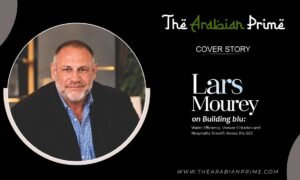
An everyday shower may appear to have little connection with sustainability strategy, operating costs or commercial innovation. For Lars Mourey, Founding Partner of Dubai-based blu Intelligent Health Solutions, bringing those elements together has helped shape a business operating across consumer retail, e-commerce and hospitality.
Over more than 17 years, Mourey and his partner and CEO, Ahmed Elgibaly, have developed blu around a simple commercial principle: products must solve genuine customer needs while delivering value that can be understood and sustained over time. At the centre of the consumer story is the blu Ionic Shower & Filter, while the company’s hospitality work increasingly focuses on combining guest experience with practical water efficiency.
More than one million blu products have been sold, while the company also works with hospitality properties and groups across the region. Mourey’s role has remained heavily commercial, spanning sales, operations, partnerships, retail, e-commerce and customer experience, with a consistent focus on profitable growth, cash flow and long-term relationships.
In this interview with The Arabian Prime, Mourey discusses the evolution of blu Intelligent Health Solutions, water efficiency and shower filtration, sustainable hospitality, commercial partnerships and the realities of scaling a business across the UAE and wider GCC.
What first led you into the world of business, entrepreneurship, and commercial growth, and how did your early experiences shape the way you approach opportunities today?
What draws me to business is the challenge of turning a real customer need into something people will choose and continue to trust. An interesting idea is only the beginning; the work is making it useful, commercially viable and dependable.
Working across different markets and sales channels has reinforced the importance of listening before assuming. A retail customer, an online shopper and a hotel operator may consider a similar product for very different reasons.
That shapes my approach today. I want to understand the customer, test the assumptions and stay close enough to the business to see what is actually happening. The opportunity becomes meaningful when we can deliver value repeatedly, not just explain it convincingly in a presentation.
What was the original idea or market opportunity that led you and Ahmed Elgibaly to establish blu, and what did you hope the company could become when you started?
I would describe the opportunity as bringing more attention to an overlooked everyday experience: the shower. It is a familiar product category, but familiarity should not stop us asking how the experience could be improved.
At blu Intelligent Health Solutions, that means connecting shower filtration, product design, customer care and, for hospitality, water efficiency. My partner and CEO, Ahmed Elgibaly, and I want the business to offer more than a product that sells once. We want a brand customers trust, supported by reliable service and long-term relationships.
The blu Ionic Shower & Filter sits at the centre of that story. Our ambition is to make the value clear to households while developing a commercially relevant proposition for hotels and other professional buyers.
How has your experience across consumer retail and e-commerce influenced the way blu develops, positions, and commercializes its solutions?
Retail gives you immediate feedback. E-commerce shows you where the explanation is working and where customers hesitate. Together, they keep us focused on what people understand, value and experience after purchase.
For consumers, the conversation often starts with their shower routine, hair and skin concerns, ease of installation and ongoing maintenance. We should address those motivations without turning them into promises we cannot substantiate. When customers describe softer-feeling hair or less dry-feeling skin, that is their experience, not clinical proof.
For hotel buyers, the discussion shifts towards performance, servicing, guest feedback and operating costs. Those different perspectives help us improve not only how blu communicates, but also how we support customers throughout ownership.
You have spent much of your career turning opportunities into commercial businesses. What helps you determine whether an idea has genuine market potential?
I ask whether we have identified a real problem, a reachable customer and a workable way to make money solving it. All three matter. Strong demand is not enough if the cost of serving it leaves the business with no sustainable margin.
I also distinguish enthusiasm from evidence. Compliments about a concept are encouraging, but paid orders, repeat purchases and successful trials tell us more.
For a new blu opportunity, I would look at customer benefit, pricing, distribution, maintenance requirements and the working capital needed to support growth. I prefer testing those assumptions on a manageable scale before expanding. A promising idea becomes a business when it works beyond the first presentation and the first sale.
Developing markets and partnerships has been central to your role. What makes a partnership commercially meaningful rather than simply strategically attractive on paper?
A meaningful partnership changes what we can achieve together, not just whose logo appears on a presentation. It should bring customers, execution capability, expertise or service coverage that creates value for both sides.
I want clarity about responsibilities, commercial terms, stock, marketing, customer support and how performance will be reviewed. A strong introduction without anyone accountable for delivery is not a growth strategy.
For blu, the right partner must also care about the customer experience. Selling the first order is only part of the relationship; availability, product guidance and after-sales support matter just as much. I would rather build a smaller, dependable partnership than announce a larger one that cannot deliver on its promises.
How does blu approach water efficiency in a way that considers not only environmental impact but also operational performance and commercial value?
We start with the property’s operating reality rather than a headline savings percentage. Existing flow rates, water pressure, occupancy, shower use, maintenance and guest expectations all influence the outcome.
For blu’s hospitality solutions, the approach is to assess the installation, select an appropriate configuration and evaluate the business case using the property’s own costs. Where a trial is appropriate, the aim is to measure performance and gather operational and guest feedback before a wider rollout.
Lower shower-water use can also reduce the hot water that needs heating, but projections must state their assumptions. Equipment, installation and servicing costs belong in the calculation too. The strongest sustainability proposition is one the engineer can operate, the guest can enjoy and the finance team can understand.
Building teams has been an important part of your role at blu. What qualities do you look for when bringing people into a growing organization?
I look for people who take ownership, communicate honestly and genuinely care about the customer. Experience matters, but so does what someone does when a problem falls outside their job description.
As a business grows, it also needs people who can strengthen processes without losing responsiveness. A customer should not feel the difference between departments; they should experience one company taking responsibility.
My responsibility is to provide clear expectations, useful feedback and room for people to contribute. Hiring capable people and then controlling every decision defeats the purpose. The goal is a team that can solve problems confidently, challenge weak assumptions and uphold standards even when a founder is not in the room.
What role do strategic partnerships play in helping blu take sustainable solutions into new markets and applications across the GCC?
Partnerships help us enter markets with a better understanding of local customers and the practical requirements of serving them. Expansion should not mean shipping products into a country and assuming the rest will take care of itself.
For blu, that means choosing partners who can support distribution, product availability, customer education and after-sales service. In hospitality, it also means working with owners, operators, engineering teams and procurement colleagues so that a proposed solution fits the property.
I see the GCC opportunity as building the right relationships market by market, rather than chasing presence everywhere at once. Sustainable expansion requires a repeatable service model and a commercial structure that gives both blu and its partners a reason to invest for the long term.
How do you personally balance short-term commercial opportunities with decisions that may create stronger value over a longer horizon?
I ask two questions: does the opportunity help the business now, and does it strengthen the business we want to have later? Sometimes the answers align; sometimes a decision requires restraint.
Revenue that damages margin, ties up cash or creates obligations we cannot support is not automatically good growth. Equally, avoiding every investment with a delayed return would prevent us from improving products, people and customer service.
I prefer decisions with clear economics, manageable downside and a practical way to review progress. That might mean testing a channel before expanding it or choosing a reliable partner over a larger immediate order. The objective is not simply to grow faster, but to build a company that can sustain its growth.
After more than 17 years of building and growing a business, what principles have remained constant in the way you work?
Keep your promises, understand your numbers and address problems before they become harder to solve. Those principles remain useful regardless of how the business or the market changes.
I also believe that trust is built after the sale. How we handle a question, a maintenance issue or a disappointed customer often says more about blu than the original sales pitch. A long-term brand needs consistency across those moments.
Another constant is remaining open to correction. Persistence matters, but persisting with an assumption after the evidence changes is not the same as commitment. Ahmed and I want blu to retain its entrepreneurial energy while becoming more disciplined about execution. The principles should remain steady even when the methods need to change.
As technology continues to evolve, what areas of innovation could have the greatest impact on water efficiency and sustainable hospitality?
I see significant opportunity where product engineering and measurement come together. A more efficient shower is valuable, but the ability to understand its performance in an occupied property makes the decision more useful to management.
Better metering and analysis could help distinguish changes caused by the equipment from changes in occupancy or guest behaviour. Innovation should also improve durability, ease of maintenance and the consistency of the shower experience.
In filtration, I am interested in performance under realistic temperatures, flow rates and service conditions, rather than impressive results presented without context. For sustainable hospitality, the most useful innovation is not necessarily the most complicated. It is something a property can install, maintain and evaluate without creating an unreasonable burden for staff or guests.
What would you like people to understand about your contribution to blu beyond your title as Founding Partner?
My contribution is connecting the commercial opportunity with the everyday work needed to deliver it. That includes sales, operations, partnerships, retail, e-commerce and the customer experience across those channels.
I am interested in the detail because that is often where strategy succeeds or fails: whether the product explanation is clear, whether stock is available, whether a hotel business case is realistic and whether a partner follows through.
Ahmed, as CEO and my partner, and our wider team are central to that work. I do not see the company as one person’s achievement. As Founding Partner, I want to help blu grow profitably while strengthening the relationships, standards and capabilities that make the business valuable beyond any individual.
When you look back years from now, what would make you feel that the journey of building blu was genuinely worthwhile?
I would want to see a company customers still trust and a team capable of taking it further. Commercial success matters, but I would not measure the journey only through revenue or the size of the business.
It would be meaningful to know that blu improved an everyday experience for households and helped hospitality customers make sensible, measurable decisions about water use. I would also value the careers developed within the company and the partnerships that endured through difficult periods.
Ultimately, I would like the business to be stronger because of the way we built it, not dependent on the founders being involved in every decision. That combination of customer value, capable people and lasting relationships would make the journey worthwhile.
What advice would you give an entrepreneur who is moving from the early stages of building a business into the much more complex challenge of scaling it?
Do not scale what you have not yet made repeatable. Growth puts pressure on everything: cash, stock, people, service and decision-making. Problems that are manageable in a small business can become expensive when multiplied.
Know your margins and cash requirements, not just your sales. Build clear responsibilities and basic systems before complexity forces you to do so. Bring in people with strengths you do not have, and give them the authority to contribute.
At the same time, stay close to customers. Processes should help the business serve them better, not become a reason to stop listening. My simplest advice is to build a company that earns the next stage of growth through reliable delivery, rather than pursuing growth as proof of success.