
The Ethical Geologist – Patrick Allman-Ward: Pioneering Responsible Energy and Mining Across Global Frontiers
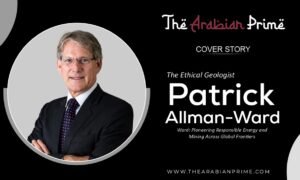
For centuries, explorers have been drawn to the beautiful country of Zimbabwe because of its treasures, both above as well as below ground. However, for Patrick Allman-Ward, the landscape is more than simply beautiful, it is a canvas on which to carry out a modern-day treasure hunt. A palpable sense of anticipation permeates the atmosphere at Terra Mining’s operations, where the prospect of producing gold from its mining operations in the country has turned into something substantial and concrete. Patrick is the Chairman of this endeavor but also, by virtue of his background as a hard rock geologist, is making a contribution to the company’s plans to further develop its gold production in the country. The vision is to convert the wealth from the earth to something that will ultimately benefit the people who live above it. He does not view mining as an end in itself; rather, he sees it as a way to responsibly utilize the natural resources of the land while ensuring that the work of the mining companies will have a positive effect on the surrounding communities.
Patrick also serves as Vice Chairman of United Terra Enterprises (U.T.P). As a non-executive member of the board Patrick is involved in developing the strategy and future business development initiatives for the company. An exciting component of this strategy is to expand from the current oil production business into developing renewable energy sources both in the form of solar P.V. as well as wave power. U.T.P is in the process of identifying and implementing new renewable energy opportunities with the objective of ultimately having several of these new renewable energy sources in place to create a well-rounded traditional as well as renewable energy portfolio within the coming years. Patrick’s commitment to creating a diversified energy portfolio is based upon his conviction that energy generation of the future must be as clean as it is dependable.
In addition to these important responsibilities, Patrick remains a sought-after consultant in the petroleum industry. Over more than 44 years in the upstream oil & gas industry and as the CEO of Dana Gas for over ten years, managing assets in both Egypt and the Kurdistan Region of Iraq, Patrick has developed expertise in both the technical aspects of oil & natural gas management, but also in assisting organizations to navigate very complex geo-political environments. Patrick’s approach to problem solving involves a commitment to understanding the fundaments of the issue, acquiring new information leading to a truly holistic appreciation of the challenge and to be unafraid of challenging conventional wisdom to find a practical and pragmatic solution. His journey will continue to develop based on the rich cross-fertilization from detailed consulting work combined with high-level strategic thinking of global mining and energy organizations.
The Hammer and the Cliff Edge
Patrick’s journey began not with oil, but with a childhood image in an encyclopedia: a geologist with a hammer on a cliff edge. That fascination led him from a global childhood (Bangkok, Jakarta, Istanbul) to a Ph.D. in Mining Geology from Imperial College. He joined Shell in 1982 as a Petroleum Geologist, spending 30 years there. Early on in his career, he witnessed a Shell Malaysia CEO dissect a flawed development well-drilling proposal, spotting a wrong input factor in the model, resulting in the saving of millions of dollars. That taught him that while leaders need ‘helicopter vision’, in other words, to see the ‘big picture,’ they also need to have enough of a grasp of the details to challenge assumptions.
Forging Leadership in the Empty Quarter
His leadership was truly forged as CEO of South Rub Al-Khali (SRAK) in Saudi Arabia (2003–2009), a Shell-Total-Aramco joint venture. Building a company from scratch in the Empty Quarter, managing a $1 billion exploration budget, and surviving an Al Qaeda attack on his office and compound taught him calmness under fire, the importance of HSSE, and how to align demanding shareholders.
The Philosophy of CEO as a Service
At Dana Gas (2013–2024), Patrick inherited a company with $1 billion in overdue receivables and complex arbitrations. His leadership philosophy crystallized around the principle of leadership as being ‘CEO as a service, not CEO as an ego.’ He focused on relentless cost reduction (50% G&A cuts), operational delivery (production growth to 65,000 boepd), and sustainability (47% flaring reduction). The key lesson? A leader’s job is to enable others to be great, not to self-advertise.
Returning to the First Love: Hard Rock Geology
Post-retirement, he remained passionate about applying his geological and leadership skills. Terra Mining holds gold mining licenses in Zimbabwe and is expanding across Africa. He was inspired because mining represents his first love—hard rock geology—and offers a chance to build something from the ground up again, much like SRAK. Long-term, he envisions Terra Mining becoming a model for responsible African mining: using modern exploration techniques, employing local talent, adhering to strict environmental standards, and proving that mining can drive sustainable development, not just resource extraction.
Strategic Growth and the African Frontier
Terra Mining is targeting expansion across Africa.
Strategic priorities:
(1) Secure and develop high-potential gold assets beyond Zimbabwe,
(2) Build local, high-performing teams,
(3) Establish partnerships with governments and communities, and
(4) Implement world-class HSSE and governance standards from day one.
Challenges: Geopolitical instability, infrastructure gaps (power, transport), regulatory unpredictability, and security risks.
His experience in Nigeria, Saudi Arabia, and the Kurdistan Region of Iraq (KRI) taught him to expect the unexpected. The solution is meticulous forward planning, deep cultural respect, and building trust with all stakeholders, not just signing agreements and leaving.
Sustainability as a Non-Negotiable Standard
Patrick and his team are embedding the same sustainability framework he established at SRAK and Dana Gas. This means that zero harm to people and the environment is not-negotiable. They implement proactive asset integrity programs, not reactive ones. They will avoid pollution and toxic runoff. They engage communities early on health, education, and local employment. At Dana Gas, they achieved carbon-neutral production for Pearl Petroleum (the Exploration and Production Joint Venture in the Kurdistan Region of Iraq in which Dana Gas is a 35% partner) and top-quartile carbon intensity metrics (less than 8 kilos per barrel of oil equivalent). At Terra Mining, they will aim for similar benchmarks: transparent reporting and feasibility studies into renewables to power remote operations.
The False Trade-Off: Commercial vs. Moral Logic
When it comes to the balance between commercial success and environmental/community responsibility, there is no trade-off. In the long run, they are the same. A company that pollutes or ignores communities will face protests, lawsuits, and license cancellations—destroying shareholder value. At Dana Gas, Patrick’s focus on HSSE enabled a 7-year LTI-free run and a 30% reduction in process safety events, which also improved uptime and profitability. He balances by applying a simple rule: Make decisions as if your family lived next to the operation. If it wouldn’t be safe or clean for them, don’t do it. That aligns commercial and moral logic.
Bridging the Energy Gap in Emerging Markets
As Vice Chairman of United Terra Enterprises, Patrick sees a future energy mix evolving in the Middle East and Africa. Gas is the bridge. The Middle East will continue using gas for power and petrochemicals, but solar is becoming incredibly cheap. Africa has vast renewables potential, but needs base-load power—gas can provide that while leapfrogging coal. He sees a hybrid future: gas plus large-scale solar, with battery storage and green hydrogen emerging post-2030.
The Ethics of the Global Carbon Budget
However, he believes it’s grotesquely unfair for developed countries that used up 60% of the global carbon budget to tell Africa not to develop its gas resources. The conversation should be about emissions, not hydrocarbons. At United Terra, they are exploring opportunities for integrating hydrocarbons and renewable energy systems, including solar PV and wave power.
Technology as a Tool for Human Empowerment
Also, Patrick sees a huge role played by the emerging technologies (AI, automation, data analytics) in transforming mining and energy but they are tools, not strategies. At Dana Gas, he and his team used 3D seismic and advanced seismic data analytics and detailed reservoir modeling to improve exploration and success rates and optimize production. In mining, AI can process geological data to target drilling, while automation improves safety in hazardous areas. However, technology must serve the people. He’s seen too many ‘digital transformation’ projects fail because leaders forgot to bring their teams along. His advice is to adopt technology to augment human decision-making, not replace it, and always invest in upgrading employees’ talent both through on-the-job and formal training.
The Essential Trifecta of High-Stakes Leadership
When it comes to leadership traits that are essential to navigate complex, high-stakes industries, three stand out: Vision, Patience, and Decisiveness. A leader must know where they want to go (Net Zero by 2050 is a vision). But Patrick believes a leader must also listen to the organization and stakeholders—don’t dictate every turn. Then, have the courage to choose a path.
The Strength of Humility and Guarded Perspectives
Additionally, humility is critical. Patrick’s psychological assessment report noted that he can be seen as ‘cold’ or ‘arrogant,’ but that’s often just a reflection of a reserved exterior. Real leaders lower their guard, admit what they don’t know, and ask for help. Finally, resilience—the industry will knock a leader down. Patrick believes you simply have to get back up again and carry-on.
Systematic Risk Governance and the Professionalism of Preparation
Patrick is naturally risk-avoiding, not risk-seeking. He approach risk governance is systematic: (1) Identify all risks (technical, political, HSSE, reputational), (2) Quantify them probabilistically, (3) Mitigate what you can (e.g., forward planning for security in Saudi Arabia), (4) Transfer or share what you can (e.g., insurance, partnerships), and (5) Accept only residual risks that are clearly understood by the Board. At Dana Gas, he insisted on asset integrity process safety systems. In new ventures like Terra Mining, they conduct red-team exercises: “What if the government changes? What if the price of gold drops 30%?” Having a plan for worst-case scenarios is not pessimism; it’s professionalism. Hope for the best, but plan for the worst.
Navigating Three Dominant Global Industry Trends
Through his consultancy (IGZACT FZE), there are three dominating trends that he is advising clients to prepare for. (1) The energy transition is real but uneven – clients must decarbonize their existing operations (methane, flaring) while investing in new energies. Don’t bet the farm on hydrogen in 2026. (2) Geopolitical fragmentation – supply chains are regionalizing. Companies need local partners and multiple supply routes. (3) Talent wars – the industry lost its narrative. It needs to attract young people again by emphasizing purpose (providing affordable and reliable energy to billions) and technology (AI, drones, remote sensing). If we only talk about ‘phasing out oil,’ no one will want to join the industry.
Foundational Guidance for Aspiring Industry Leaders
To aspiring leaders in energy, mining, and infrastructure, Patrick’s guidance is that first, become excellent at what you do before chasing the title. When he interviewed at Shell, he asked how long it would be before he could get to the top. They said, ‘First, become excellent at what you do.’ Second, ask yourself why you want to lead. If it’s for money or admiration or ego, you’ll fail. Great leadership is about enabling others.
The Power of Discomfort, Meditation, and Legacy
Third, embrace discomfort. His toughest roles—SRAK, Dana Gas during the oil price crash—taught him the most. Fourth, meditate. He’s been doing transcendental meditation since 18. It gives his brain space for insights. Finally, he remembers his father’s advice, which he found inspirational, and he hopes will inspire others: ‘Leave the world a better place than you found it.’
The Threefold Legacy of a Principled Leader
As one of the most influential business leaders in the Arab world, Patrick doesn’t seek public acclamation or awards. His legacy is threefold: First, that he built companies (SRAK, Dana Gas) that were safe, profitable, and respected—where people genuinely wanted to work. Second, he demonstrated that a major oil and gas company can decarbonize (47% flaring reduction, carbon-neutral production) while remaining profitable. That proves the industry can be part of the climate solution. Third, that he mentored a generation of leaders, especially in the Middle East and Africa, who are ethically grounded, technically excellent, and culturally agile. If they, in turn, leave their organizations better than they found them, that will be his true legacy.