
Unitree Soars in its Shanghai Debut, A Significant Milestone for China’s Humanoid Robotics Industry
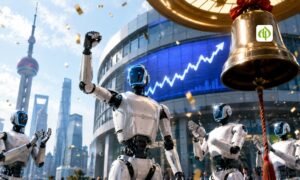
In its Shanghai trading debut, shares of Unitree (688836.SS), China’s most well-known manufacturer of humanoid robots, roughly sixfold increased. This was a historic milestone for the nation’s robotics industry, which has emerged as a crucial front in the Sino-American tech war.
Unitree, a competitor of Boston Dynamics, a company owned by Hyundai Motor Group, and Tesla (TSLA.O), has gained international recognition for its robots that can run, dance, and perform martial arts.
Supported by powerful companies, both state-run and private-sector tech titans, it is one of the largest manufacturers of humanoid and quadruped robots in the world and a source of pride for the Chinese people.
Even though just a small percentage of its robots are used in commercial settings, it is profitable, in contrast to the majority of its competitors. Although it is not the first Chinese manufacturer of humanoid robots to go public, its listing is anticipated to set the standard for several domestic competitors who are getting ready to enter the market. Yan Kai, a venture capitalist and partner at Ivy Capital in Shanghai, stated, “It is a top-tier player, and its uniqueness commands premiums.” Rather than valuation methods, political and economic factors determine its price.
On the tech-focused STAR Market, the stock ended the morning session at 883.87 yuan, far more than its IPO price of 150.8 yuan and valued the company at over $50 billion.
After opening at 1,100 yuan, the day’s high, it lost some of its gains.
That increase is far more than the average first-day pop of 279% for new share offerings in China so far this year. Additionally, it opens a new tab and contrasts with a 2% decline in Chinese benchmark indices (.SSEC), with tech shares falling victim to significant selling.
The launch coincides with the start of the World Robot Conference in Beijing, where hundreds of primarily Chinese businesses will be showcasing innovations and introducing new goods that the government believes will help address the labor shortage brought on by China’s demographic crisis.