
The Sensory Visionary – Dr. Naglaa Sami Mahmoud: Redefining Human-Centered Design and Education
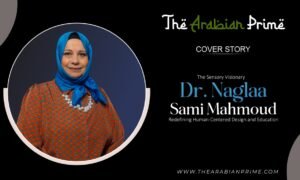
Inspiration, most of the time, is the beginning of invention. With over three decades in academia, as one of the Middle East’s most visionary leaders transforming education in 2026, Dr. Naglaa Sami Mahmoud is reinventing the art of teaching and learning. Her inspiration began with her late father, Prof Emeritus Sami Abdelaziz, who was a professor of architecture and a major influence on my early thinking. “I admired him deeply and was fascinated by the world of architecture that surrounded me.” However, even at that stage, she felt that architecture alone was not enough. She kept thinking about the people who inhabit spaces and about the need to understand their physical, emotional, and psychological needs more closely. That is why she was drawn to interior architecture. “For me, it represented the more intimate and human-centered side of design.”
Dr. Naglaa’s journey into education was also guided by her father. She graduated with the first rank in her batch among 120 students, “and my father told me something I never forgot: ‘The top graduate should lead educational progress.” That sentence stayed with her and became one of the foundations of her academic career. It made her realize that success is not only personal achievement but also a duty to contribute, teach, and help shape the next generation. “Since then, education has been, for me, a meaningful way to combine knowledge, design, and service to society.”
Shaping Design Education in the Middle East
Dr. Naglaa’s role at Ajman University has played a major role in shaping and deepening her vision for design education in the Middle East. It has given her the opportunity to work in an environment that values innovation, academic quality, and international standards, while remaining closely connected to the needs of her region. Through this experience, she has become even more convinced that the future of design education must go beyond traditional teaching methods and move toward experiential learning, interdisciplinary thinking, research-based practice, and stronger engagement with human and environmental realities.
A Multicultural Journey of Design
At the same time, her vision has also been shaped by her own multicultural journey. She spent six years of her childhood in Europe, and later three years in Paris during her PhD studies. These experiences had a profound impact on the way she sees education and design. They helped her appreciate diversity, cultural nuance, and the value of viewing design through multiple lenses. This combination of international exposure and regional academic experience has taught her that the strongest educational models are those that respect local identity while remaining open to global knowledge and innovation.
Progress and Human-Centered Mentorship
At Ajman University, she has contributed through teaching, curriculum development, accreditation, laboratory innovation, and mentoring. All of this has reinforced her belief that the Middle East is not only capable of advancing design education but also of helping shape its future globally through models that are culturally aware, technologically progressive, and deeply human-centered.
Sensory Dimensions and the Father’s Legacy
Her specialization and interest in lighting and acoustics began with her late father, who was one of the pioneering Egyptian architects to study these two fields in depth. His influence stayed with her, inspiring a lifelong fascination with the sensory dimensions of space. Later, she became the first to approach these subjects from the field of interior design, which gave her a more human-centered perspective on how light and sound affect the people who inhabit interior environments.
Redefining the Educational Experience
In educational spaces, lighting and acoustics can completely redefine the quality of the experience. They influence how students concentrate, how comfortably they see and hear, how they feel emotionally, and how effectively they learn. A classroom or studio is not successful simply because it looks good. It must support attention, communication, psychological comfort, and well-being. Lighting can stimulate focus or cause fatigue. Acoustics can support clarity and engagement or create stress and distraction. These are not secondary issues. They are central to the learning process.
Pioneering Innovation in the GCC
This conviction led her to establish the Lighting and Acoustics Lab for Interior Applications and Experimentation at Ajman University in 2019, the first lab of its kind in the GCC. It was created to give students direct, hands-on experience with the sensory and environmental realities of design. Her goal has always been to show that lighting and acoustics are not optional technical additions, but fundamental design elements that shape educational success and human experience. Dr. Naglaa received an honorable award from LIT2024 Award.
Integrating Sensory and Experiential Learning
Dr. Naglaa ensures to integrate sensory and experiential learning into her teaching methodologies. She believes that design education becomes truly meaningful when students experience space directly rather than only reading about it in theory. That is why sensory and experiential learning are central to her teaching methodology. She encourages students to observe, experiment, simulate, compare, and reflect so they can understand how environmental conditions influence human perception, comfort, mood, and behavior.
Transforming Abstract Knowledge into Lived Experience
A key example of this is the Interior Lighting Applications and Experimentations Lab at Ajman University. Through this lab, students can directly engage with lighting scenes, color effects, and acoustical variables in a practical and measurable way. Additionally, it transforms learning from abstract knowledge into lived experience. Students begin to see how design decisions affect people in real-world environments, which helps them connect theory with evidence, perception, and application.
The Heart of Design Education
For her, experiential learning is not a supplementary method. It is at the heart of design education. It develops analytical thinking, sharpens sensory awareness, and helps students become more confident and responsible designers. Most importantly, it leaves a lasting impact because students learn best when they actively test, observe, and reflect within the lab itself.
Identifying Creative Potential at the Entry Point
One of the most important gaps in interior design education begins at the entry point. She believes students should not enter design programs solely on the basis of general academic qualifications. There should also be an entry exam, portfolio, or another method of identifying creative potential, visual sensitivity, and readiness for the discipline. Interior design requires talent, imagination, observation, and the ability to think through space, not only to study it academically.
Bridging the Gap Between Creativity and Evidence
Another gap is the separation between creativity and evidence-based thinking. In some programs, students are still guided toward appearance, with insufficient emphasis on human factors, environmental performance, or scientific understanding. At the same time, sensory design, particularly lighting, acoustics, and user psychology, is still not fully integrated into many curricula, even though these are central to the quality of human experience in space.
Prioritizing Manual Creativity Over Digital Tools
She also strongly believes that the first year of study should include far more hands-on and manual application. Students today often rely on digital tools too quickly, but true imagination begins with the hand. Sketching, making, and manual experimentation help students build visual intelligence, design confidence, and a direct relationship with form and space. Technology is important, but it should come after a strong manual and conceptual foundation, not before it.
Rethinking Admissions and Curriculum
To address these gaps, institutions need to rethink both admission and curriculum. They need to select students more carefully, support manual creativity in the early stages, integrate sensory and human-centered design more deeply, and connect academic learning more closely with real practice. Only then can she and other educators prepare designers who are both imaginative and responsible, both creative and critically informed.
The Influence of Cultural Identity on Space
As a multilingual academic with global exposure, cultural perspectives deeply influence Dr. Naglaa’s approach to design and teaching because they are closely connected to identity, which is essential to how people experience space. Her own journey across different cultural contexts, including six years of childhood in Europe, her academic formation in Egypt, and three years in Paris during her PhD, helped her understand that design is never neutral. It is shaped by values, traditions, behavior, memory, climate, and social expectations. These cultural layers influence how people perceive privacy, comfort, beauty, symbolism, and belonging within interior environments.
Multilingualism and the Interpretation of Surroundings
Being multilingual has also strengthened this understanding. Working across French, English, and Arabic has shown her that language and culture shape the way people think, communicate, and interpret their surroundings. The same color, material, lighting atmosphere, or spatial arrangement may carry very different meanings from one culture to another. This is why she believes strongly in the importance of identity in design. Spaces should not be disconnected from the people they serve. They should reflect and respect their cultural and psychological realities.
The Psychology of Culturally Responsive Design
This perspective is closely tied to her teaching, especially in the Psychology of Interior Design, where she emphasizes that interiors are not only physical environments, but also psychological experiences. Design affects emotion, perception, behavior, and human interaction. In the classroom, she encourages students to approach design with sensitivity rather than assumption, and with an awareness that successful spaces must be culturally responsive, psychologically supportive, and meaningful to their users. For her, design education should prepare students not only to be technically capable, but also to understand the identity and inner experience of the people for whom they design.
Interdisciplinary Collaboration as a Necessity
She believes that interdisciplinary collaboration is essential because the challenges of the built environment can no longer be solved by a single discipline. Interior design today must engage with engineering, sustainability, psychology, digital technology, health, and management. She always tells her students that good design does not happen in isolation. It develops through dialogue, shared knowledge, and the ability to connect creative ideas with technical, environmental, and human realities.
Preparing Future-Ready Integrated Designers
In education, this means helping students understand that every design decision has multiple dimensions. Lighting relates to energy and visual comfort, acoustics to concentration and well-being, and material selection to health, sustainability, and performance. When students learn to collaborate across disciplines, they become more adaptable, responsible, and professionally prepared. In her view, future-ready designers must be able to communicate clearly, think beyond their own field, and transform ideas into integrated, evidence-based solutions.
The Wise Integration of Technology and AI
Emerging technologies, including AI, are transforming interior architecture by changing how students and professionals research, visualize, analyze, and develop design ideas. In education, these tools can expand conceptual exploration, improve simulation, and support faster access to information. In professional practice, they enhance visualization, environmental analysis, technical coordination, and workflow efficiency. However, Dr. Naglaa believes the key issue is not simply using technology, but using it wisely. Technology should support human intelligence, not replace critical thinking, originality, or ethical responsibility. In her teaching, she encourages students to use AI as a tool for exploration, support, and informed decision making, while preserving authorship, reflection, and design judgment. The designer must remain the thinker who questions, evaluates, selects, and gives meaning. For her, the future of design education lies in preparing students who are technologically capable yet intellectually grounded, human-centered, and culturally aware.
A Legacy of Purposeful Mentorship
Dr. Naglaa’s mentorship philosophy is deeply influenced by the example of her father and mentor, and in many ways, she carries forward the same spirit of guidance in her own academic life. She believes mentorship is not about giving ready answers, but about helping students discover their strengths, refine their thinking, and build confidence with discipline and integrity. A mentor should open pathways, ask the right questions, and help students develop their own voice. Her multicultural exposure and long academic experience have also helped her work effectively with different personalities, aspirations, and learning styles. This has made her mentorship more responsive, patient, and human-centered. She always tries to support students both academically and professionally, while encouraging them to pursue higher goals, including postgraduate study and research. For her, successful mentorship means helping students become thoughtful, resilient, ethical, and independent professionals.
The Intersection of Sustainability and Well-being
Over the next decade, Dr. Naglaa believes sustainable and human-centric design will become even more interconnected. Sustainability can no longer be understood solely in terms of materials, energy, or technical compliance. It must also include human well-being, cultural relevance, psychological comfort, and long-term social value. For her, true sustainability also means preserving identity and respecting the origins of each culture, rather than producing spaces that feel disconnected from their people and context. She expects future design to move toward more integrated models that combine environmental performance, sensory quality, and human experience. Designers will need to respond to climate pressures, changing lifestyles, wellness priorities, and the demand for inclusive and adaptable spaces. This evolution requires research-informed decisions and stronger ethical awareness. The future of sustainable design is not only greener; it is more humane, more culturally grounded, and more responsive to everyday life.
Leading Global Design from the Middle East
As an APID Ambassador and contributor to global platforms, she sees that the Middle East is well-positioned to contribute meaningfully to global design leadership if it continues to invest in education, research, cultural identity, and innovation. The region has already shown remarkable ambition in architecture, urban development, and higher education. Still, the next step is to strengthen knowledge production, thought leadership, and research-driven practice rooted in her own context. She believes the Middle East can lead in climate-responsive design, human-centered educational environments, sensory design, and culturally grounded innovation. This vision is also inspired by pioneers such as Mrs. Farida Alawadhi, the first lady to study interior design in the UAE, an APID leader, and a figure who contributed greatly to advancing the field. Her region has the diversity, talent, and responsibility to move from importing models to producing globally relevant design knowledge and leadership.
Empowering the Next Generation of Women Leaders
Dr. Naglaa’s advice to aspiring women educators and designers aiming to make a lasting impact in this field is to believe deeply in the value of their perspective and the importance of their contribution. She believes they should invest in knowledge, develop their voice, and remain committed to excellence even when the path is demanding. Women may face resistance, doubt, or challenge, but they must hold on with strength, dignity, and confidence. For her, lasting impact does not come from visibility alone; it comes from substance, consistency, and the courage to lead with competence and integrity.
Turning Challenges into Opportunities for Growth
She would encourage them to see challenges not as reasons to retreat, but as opportunities to grow stronger and more focused. In her view, there is no shortcut to any place worth going, but passion is the shortcut. She suggests they should continue learning, seek mentorship, support one another, and aim not only for personal success but also to open doors for others and create meaningful change.